Vents MagaZine Music and Entertainment Magazine
Related Articles



By Venessay May
Reviewed September 2026 · Hands-on test scope: BaZi profile creation and generated chart
Disclosure: I discovered OpenFate.ai through a Google search. This is an independent review and is not affiliated with or sponsored by OpenFate.ai.
| What was tested | What was not tested | Best fit |
| Profile creation and a generated BaZi chart, including visible time handling, Four Pillars, Ten Gods, element data, and luck cycles. | Paid AI reports and the other available systems were not independently hands-on tested for this article. | Readers who want detailed chart data they can inspect alongside the interpretation. |
OpenFate AI is worth exploring if you want detailed astrology charts, access to Eastern and Western traditions, and explanations connected to visible chart information. Its strongest feature in this walkthrough was the ability to inspect the birth inputs, calculated chart, and interpretation together.
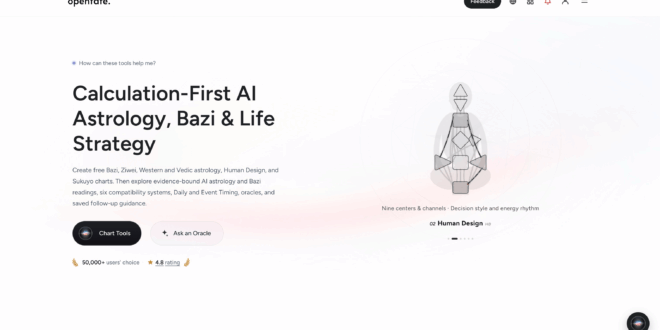
The platform brings BaZi, Zi Wei Dou Shu, Western astrology, Vedic astrology, Human Design, and Sukuyo into one product. It also offers compatibility readings and oracle tools. That breadth makes it appealing to people whose interests extend beyond a single astrology system.
There is a learning curve, however. Some terminology needs more explanation, and parts of the advice can repeat. The best starting point is the free chart: use it to judge whether OpenFate’s approach helps you understand the material before paying for a longer reading.
What Is OpenFate AI?
OpenFate AI is an astrology and self-discovery platform built around a distinction between chart calculation and interpretation.
According to its published methodology, chart engines establish structured results first and AI then uses that information to provide explanations. For a reader, the intended benefit is straightforward: there is visible chart data behind the narrative that you can inspect and question.
Its product lineup includes:
- BaZi: Four Pillars charts and readings.
- Zi Wei Dou Shu: a Chinese metaphysics system with its own chart structure.
- Western and Vedic astrology: access to different astrological traditions.
- Human Design and Sukuyo: additional frameworks for exploration.
- Compatibility and oracle tools: relationship-focused readings and systems such as Tarot, Liuyao, and Qimen Dunjia.
This review’s completed hands-on testing covered profile creation and a generated BaZi chart. The other systems are described as available features, not as independently tested results.
The Core Value: See the Chart Behind the Explanation
An interpretation is easier to assess when you can see what it refers to.
In the BaZi walkthrough, OpenFate displayed the entered birth details alongside the generated Four Pillars, hidden stems, Ten Gods, element distributions, and luck cycles. Explanatory text appeared with that structured information.
That creates a more useful way to explore the reading. Instead of asking whether an entire personality summary simply “sounds right,” you can inspect a specific chart feature and ask how it connects to the explanation.
OpenFate’s calculation and AI methodology provides further context for that separation. It is first-party documentation rather than an independent audit, but it gives readers specific conventions and claims they can examine.
Calculation transparency also has an important boundary: a reproducible chart does not establish that its personality interpretations or future-event claims are scientifically validated.
What the BaZi Walkthrough Actually Showed
The walkthrough used February 3, 1998, at 3:00 p.m. in Brooklyn, New York, with Male selected for the calculation.
The birthplace search returned several places called Brooklyn. Selecting the New York City result was an important step, and the confirmation screen made the chosen details visible before saving.
The generated result then showed:
| Detail | Observed result |
| Entered birth time | 15:00 |
| True Solar Time | 14:50 |
| Day Master | Xin Metal |
| Four Pillars | Ding Chou, Gui Chou, Xin Si, Yi Wei |
| Luck-cycle direction | Backward |
The visible time correction was especially useful because the recorded 15:00 time and the 14:50 True Solar Time fall on opposite sides of the 15:00 two-hour boundary. The adjustment was therefore visible rather than hidden behind the final chart.
These are recorded product outputs from the walkthrough. They were not independently checked against a second BaZi calculation engine.
The result extended into chart interactions, annual sections, and assessments of framework, formation, and disruption. It also qualified its numeric theme scores as structural signals rather than guaranteed events.
What OpenFate Does Well
Substantial detail before a longer reading
The generated free chart contained enough information to evaluate the presentation without buying a paid report for this review. Experienced BaZi readers can inspect the tables, while beginners can start with the explanations and work toward the terminology.
Several traditions in one platform
OpenFate’s breadth is useful for people interested in more than one system. It provides a shared place to explore Chinese metaphysics, Western astrology, and other traditions. The convenience is real, but agreement between different readings should not be treated as independent confirmation of a personal claim.
A place for real-life context
The profile flow includes optional background information separately from birth details. That is a thoughtful distinction:
a chart cannot establish someone’s employment situation, relationship history, or present concerns. Giving users a separate place to provide context makes that information available without pretending it came from the birth chart.
Whether every later AI response consistently preserves that distinction was not tested here.
Material readers can question
The strongest product quality in this walkthrough was traceability: visible inputs, structured output, and explanations connected to the chart. That encourages a more useful interaction than simply accepting a conclusion. Readers can identify the part they do not understand and investigate it.
Where OpenFate Could Improve
The English BaZi output mixes Chinese terms with abbreviations such as 7K, EG, IR, and IW. Those labels may be familiar to experienced readers, but clearer explanations beside them would make the product more accessible.
Some annual advice also repeated. Similar suggestions about slowing decisions and documenting boundaries appeared across several years, making the practical differences less clear.
There was also an unresolved tension between a section emphasizing strong execution and another describing slow action. Those characteristics could refer to different dimensions, but the explanation should connect them explicitly.
Finally, numeric scores can appear more objective than their underlying framework warrants. A wealth signal of 62/100 is not a measured probability of financial success. Readers should preserve the product’s own distinction between symbolic signals and real-world outcomes.
Pricing and Privacy
During the review, the live OpenFate pricing page displayed one-time packages of CNY 52 for 250 credits, CNY 88 for 500 credits, and CNY 149 for 1,000 credits, with the cards describing those credits as non-expiring. Pricing, currency options, included usage, and available plans can change, so readers should check the live pricing page before purchase.
No paid report or report-specific follow-up conversation was completed for this article, so paid value remains untested.
OpenFate’s privacy policy describes processing of birth details, chart inputs, prompts, chats, and reports, including relevant information shared with AI service providers when needed to generate outputs. It also describes AI Memory as enabled by default, with settings to review, disable, or delete stored memory. Review those settings before adding sensitive personal context.
Verdict: Who Should Try OpenFate AI?
OpenFate is a promising choice for people who want detailed traditional charts and a structured way to explore their interpretations. The completed BaZi walkthrough showed a concrete product with visible time handling, substantial chart information, and explanations that invite further questions.
It is a less natural fit for someone seeking an immediate, jargon-free answer or a scientifically validated personality assessment.
A sensible way to try it is to start with one system and one question. Check the inputs, examine the chart, and compare the interpretation with your actual experience. If that process helps you think more clearly, you have a grounded reason to explore further.
Try the free BaZi chart: openfate.ai/en/bazi-chart
Sources referenced for product context
The hands-on observations above come from the reviewer’s test. The following first-party OpenFate pages were checked for current product, methodology, and privacy context; they are not independent audits.
- OpenFate homepage / product overview: https://openfate.ai/en
- BaZi calculation methodology: https://openfate.ai/en/bazi/calculation-methodology
- Privacy Policy: https://openfate.ai/en/privacy
- Terms of Service: https://openfate.ai/en/terms
Editorial note: Astrology, BaZi, Human Design, and related metaphysical systems are interpretive traditions. Reproducible chart calculations do not by themselves validate personality, compatibility, or forecasting claims.