Vents MagaZine Music and Entertainment Magazine
Related Articles



For most of my career, I’ve been the person who had good ideas but couldn’t seem to land them.
I’d sit in meetings, rehearse what I wanted to say, finally say it, and watch it fall flat. Someone else would make almost the same point twenty minutes later and get heads nodding. It was infuriating, but besides the emotion it didn’t seem to matter too much.
Then I got passed over for a promotion I’d been working toward for two years. My manager was kind about it. She said I was technically strong, well-liked, a solid contributor. But I “struggled to command the room.” That phrase sat with me.
When I started looking for a new role, I made a decision: I wasn’t going to walk into the next chapter of my career with the same problem. I had about three months. I was going to use that time.
What followed was an accidental reading binge. I didn’t plan to read seven books on public speaking. But each one led me to the next, and somewhere in the middle of it all, something shifted. In interviews. In meetings. In how I showed up when I had something to say.
I start my new job in four weeks. Here’s what I read.
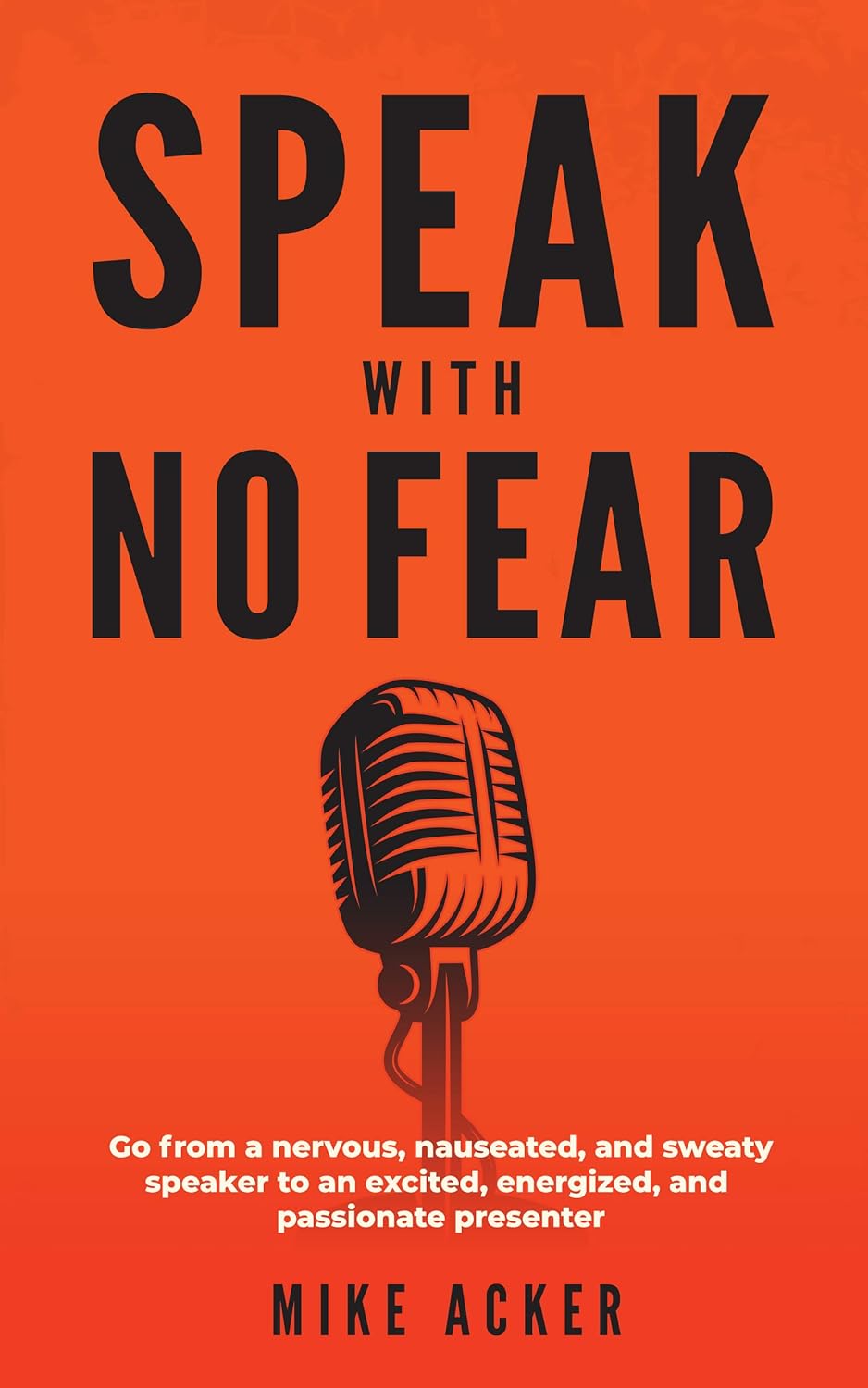
1. Speak With No Fear — Mike Acker
I started here because the title felt embarrassingly accurate. I was afraid. Not just of stages or spotlights, but of that specific fear of saying something and having it not land. Of taking up space and not being worth it.
Acker’s book is short, direct, and surprisingly funny. He writes like someone who has sat across from a lot of people who feel exactly like I did. His seven strategies work because they get at the root of the fear before they try to fix the behavior.
I read it in one sitting. I’ve recommended it to three people since.
2. Talk Like TED — Carmine Gallo
After Acker dealt with the fear, I wanted something more structural. Gallo’s book came up everywhere, so I picked it up.
The premise is straightforward: Gallo analyzed the most-watched TED talks and reverse-engineered what they have in common. The result is nine principles covering storytelling, novelty, passion, and brevity. What stuck with me most was his argument that the best communicators don’t just inform. They make people feel something first, and then the information sticks.
I started applying this almost immediately. Instead of leading with data in my weekly update calls, I’d open with a quick story or a provocative question. The difference in engagement was noticeable within a week.
3. TED Talks: The Official TED Guide to Public Speaking — Chris Anderson
I read this one right after Gallo, and I’d recommend doing the same. Where Gallo analyzes TED from the outside, Anderson built it from the inside. This book reads like a masterclass from someone who has watched thousands of talks and thought hard about why some work and most don’t.
His central idea is that a great talk is simply one idea, clearly transferred from your mind to your audience’s. That sounds obvious until you realize how rarely anyone actually does it. Most of us try to say too much. Anderson is ruthless about focus, and it changed how I prepare for any high-stakes conversation, not just formal presentations.
4. The Art of Public Speaking — Dale Carnegie
At this point I was deep enough in the subject that I wanted to understand where it all came from. Carnegie is the original. He wrote this in the early 1900s and it’s still in print, still assigned in courses, still cited by coaches a century later.
Some of it shows its age. But the core is timeless: confidence comes from preparation, connection comes from caring about your audience more than your own performance, and almost anyone can learn to speak well if they commit to it. I found it grounding in a way the newer books aren’t. Sometimes it helps to be reminded that this problem is not new, and that people have been solving it for a very long time.
5. The Art of Public Speaking — Stephen Lucas
This is the textbook, literally. It’s used in more university public speaking courses than any other, and once I started reading it I understood why. It’s comprehensive in a way none of the other books are.
Lucas covers speech structure, research, delivery, argumentation, and listening with real depth. It’s not the most exciting read on this list, but it gave me a vocabulary and a framework I didn’t have before. I started understanding why certain things worked when I spoke, not just that they did. That shift mattered.
6. Presentation Zen — Garr Reynolds
By this point I realized I’d been ignoring a huge part of how I communicate at work: my slides. And my slides were, if I’m honest, terrible.
Reynolds’ argument is simple. Your slides should support your spoken message, not replace it. Less text. More space. One idea per slide.
7. Speak With Confidence — Mike Acker
I ended where I began, with Acker, and I think that’s the right order. Speak With No Fear unlocked the door. Speak With Confidence showed me what was on the other side.
Where the first book is about removing the obstacle, this one is about building something lasting. Acker’s framework centers on three things: identity, message, and skills. His argument is that real confidence isn’t a performance. It’s what happens when those three things are in alignment. You know who you are as a communicator, you have something genuine to say, and you have the skills to say it well.
I read the last chapter the night before my final interview for the job I just accepted. I don’t think that’s a coincidence.
What I’d Tell Someone Starting This Journey
Start with Speak With No Fear. It’s short, it’s honest, and it will deal with whatever is in the way before you try to build on top of it.
Then pick based on what you need. If you want structure and story, Gallo and Anderson. If you want depth and foundation, Lucas and Carnegie. If slides are part of your world, Reynolds. And when you’re ready to put it all together into something that actually comes from you, go back to Acker.
I’m not a professional speaker. I’m a manager who spent three months deciding that communication wasn’t going to be the thing that held me back anymore. These seven books are why it won’t be.