Vents MagaZine Music and Entertainment Magazine
Related Articles


Indoor air quality has become an important consideration for offices, schools, healthcare settings, hospitality venues and other shared buildings. While ventilation remains central to maintaining a healthy indoor environment, it may not always provide sufficient control over airborne particles, particularly in rooms with limited airflow or high occupancy. Commercial air purification can complement existing measures by removing selected pollutants as air circulates through a filtration system.
Why Indoor Air Quality Matters
Air inside a building can contain a mixture of dust, pollen, fibres, smoke particles, microorganisms and emissions from furnishings, cleaning products or equipment. The concentration of these pollutants varies according to the building, its location, the activities taking place and the effectiveness of its ventilation.
Poor indoor air quality may contribute to discomfort, unpleasant odours and irritation of the eyes or respiratory system. It can also affect how occupants perceive a workplace or public venue. Because people often spend many hours indoors, building managers increasingly consider air quality alongside temperature, lighting, noise and general cleanliness.
How Commercial Air Purification Works
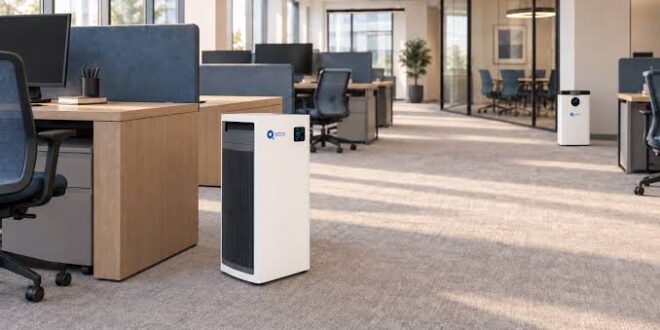
Most commercial air purifiers draw room air into a unit, pass it through one or more filters and return the treated air to the space. The effectiveness of this process depends on the filtration technology, airflow rate, room size, placement and operating schedule.
A detailed air purification guide can help building managers understand the terminology used when comparing systems. Important factors include the types of pollutants being addressed, the volume of air processed and the practical requirements for installation and maintenance.
Mechanical Filtration
Mechanical filters capture particles as air passes through a fibrous material. High-efficiency particulate air filters, commonly known as HEPA filters, are widely used where fine-particle removal is a priority. Pre-filters may also be fitted to collect larger debris before it reaches the main filter, helping to preserve performance and extend its useful life.
The presence of a HEPA filter alone does not determine whether a purifier is suitable for a particular room. The complete unit must move enough air through the filter, and the filter should be properly sealed so untreated air cannot bypass it.
Activated Carbon and Gaseous Pollutants
Particle filters are not designed to remove every form of contamination. Activated carbon filters can adsorb certain gases, odours and volatile organic compounds, although their performance depends on the quantity and type of carbon used. Carbon media eventually become saturated and require replacement, sometimes sooner in environments with persistent chemical or odour sources.
Some purification products use additional technologies, such as ultraviolet light or ionisation. These systems should be assessed carefully, including whether they produce unwanted by-products and whether independent evidence supports their stated performance.
Selecting a System for the Space
Choosing a purifier begins with understanding the room rather than comparing product labels in isolation. Floor area, ceiling height, occupancy, ventilation, sources of pollution and periods of use all influence the required capacity.
Clean air delivery rate is a useful measure because it considers both airflow and particle-removal efficiency. A unit that is highly efficient but moves little air may have a limited effect in a large or busy room. Noise is another practical consideration, as occupants may reduce the fan speed or switch off a disruptive machine, lowering its real-world effectiveness.
Placement also matters. A purifier needs unobstructed access to room air and should not be hidden behind furniture or positioned where its outlet creates discomfort. Larger or unusually shaped spaces may benefit from several smaller units rather than one device.
Operation, Maintenance and Monitoring
Air purification is an ongoing building-management task rather than a one-time purchase. Filters should be inspected and replaced according to actual use, environmental conditions and manufacturer guidance. A clogged filter may restrict airflow, increase energy consumption and reduce performance.
Maintenance plans should identify who is responsible for checks, how replacement dates are recorded and how used filters are handled. Staff may also need guidance on fan settings and operating hours. Running a system consistently during occupied periods is generally more useful than occasional operation after a room has been in use.
Indoor air monitoring can provide additional context, but readings must be interpreted carefully. Carbon dioxide monitors can indicate whether ventilation is keeping pace with occupancy, yet they do not directly measure every airborne pollutant. Particle sensors may reveal trends, although consumer-grade devices can vary in accuracy.
Part of a Broader Air-Quality Strategy
Commercial air purification works best as one component of a wider approach. Source control, adequate outdoor-air ventilation, effective extraction, regular cleaning and sensible occupancy management remain important. Purifiers should not be treated as replacements for addressing damp, mould, combustion emissions or poorly maintained ventilation systems.
A considered strategy starts by identifying the problem, assessing the space and selecting proportionate controls. When equipment is correctly sized, appropriately placed and routinely maintained, air purification can make a useful contribution to cleaner and more comfortable shared indoor environments.