Vents MagaZine Music and Entertainment Magazine
Related Articles
Global musician Ute Lemper recently sat down with VENTS Magazine to talk about her moving new single “MOTHERS”. The interview is below.
Where did the idea for “MOTHERS” first come from?
I originally wrote MOTHERS a few years ago as the title song for a television series I was hosting in Europe. The show featured mothers from all kinds of professions and backgrounds telling their stories. In the end, they chose an instrumental theme, and I moved on, but I always loved the song.
This spring it suddenly came back to me with a completely different urgency. I am a mother of four, and I became increasingly worried about my children’s future and, really, our world—wars, political division, cuts in education, social media, the internet, AI, all these enormous forces changing the world and our kids.
So I rewrote the second verse and made it much more provocative. And then the idea exploded. I thought: why not make this song in the world’s languages? Why not have mothers from All over the world, from oppositional countries, singing fundamentally for the same thing?
The song speaks about the love and protection mothers give their children. What does that mean to you personally?
Having four children has been the most profound experience of my life. You bring these human beings into the world, and suddenly you carry an incredible love, but also a lifelong vulnerability and responsibility to help them find peace and happiness.
And now two of my children are old enough to think about having families themselves. I see their hesitation. They ask themselves what kind of world their children would inherit. Sometimes I honestly wonder whether, if I were young today, I would think twice about having children.
That is painful for me to say.
Every generation has worried about its children, of course. But right now everything feels crazy complex. War, climate, technology, social media, inequality, political power and. instability. As a mother, you want to protect your children, but you also understand that you cannot protect them from the world.
So perhaps MOTHERS comes from that feeling: if I cannot protect them from everything, at least I can raise my voice.
You’ve used AI to bring your voice into several languages. Was there anything about the process that surprised you?
Yes—the sensitivity and human component, the wealth of inspiration, and the quality of the product were mind-blowing and so wonderful.
In general, I am of course nervous about AI and its potentially uncontrollable power. I think we all should be asking serious questions about where this is going. But in this project I experienced the best side of it.
The musical tools could respond to very subtle ideas about voices, instruments, atmosphere, and cultural colors and heritage. Sometimes the voices had so much soul that I was very moved. It was able to carry sadness and express sorrow; it was so powerful that it overruled the fact that is was “created by an artificial entity”. It sounded more than real to me.
But what surprised me most was where it took me creatively. I knew what I wanted, but suddenly I could experiment on a scale that would normally be impossible. AI became an extension of my capacities. It didn’t replace my imagination—it expanded the playground.
How did you make sure the technology supported the song’s message without taking attention away from it?
By treating AI as a tool, not as the author.
The song and composition already existed. The musical foundation was recorded by me with my guitarist, myself on piano and keyboards, and my drummer and percussionist. I translated and adapted the lyrics myself and checked them with native speakers.
Then came hundreds of choices. I experimented, rejected things, changed arrangements, separated the tracks, and brought everything into my good old Pro Tools system. I added voices, instrumental lines, and human elements and kept shaping the music.
I always knew what I wanted the emotional message to be. Technology had to serve that.
For me, it was almost like being a movie director. You may have an extraordinary team and extraordinary technology around you, but somebody still has to know what movie they are making.
The lyrics say that all children are equal. What do you hope people think about after hearing that message?
That a child’s life does not become more or less valuable because of the passport, religion, race, or political system they happened to be born into.
It sounds so obvious, and yet look at the world.
A mother in one country is told that the people across a border are her enemies. But the mother on the other side is protecting her child with the same instinct.
No mother wants one day her child to become a soldier and die for his country, or become the victim of somebody else’s war.
We have created all these categories and borders around ourselves. Children are born without them.
Perhaps we should remember that more often.
Your video brings together women and children from many different backgrounds. How did you develop the visual concept?
I wanted the images to transport the music into another dimension.
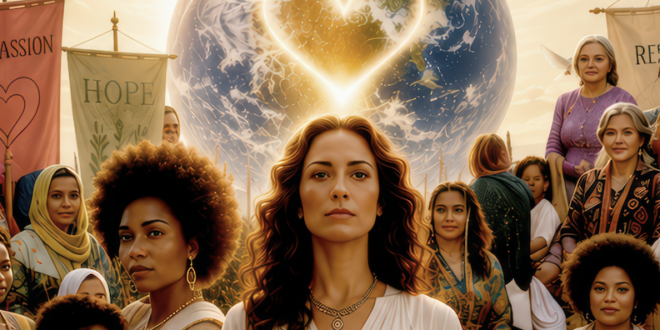
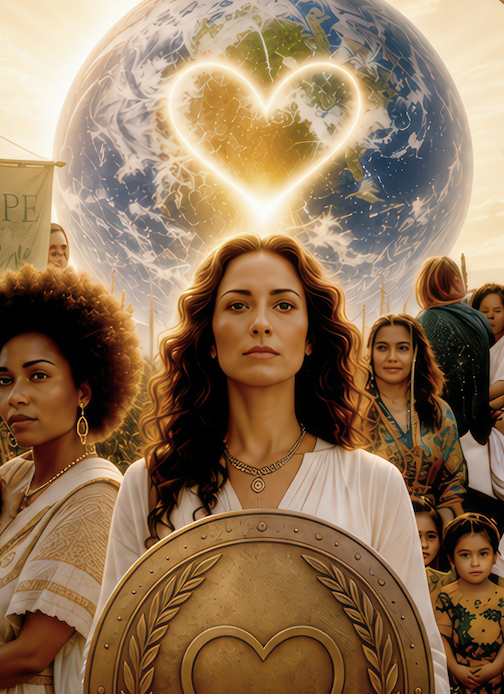
In the beginning, there is an almost mythological world: women flying on peace doves over war zones, protecting children, ancient mothers carrying the secrets of life to new generations. I wanted something poetic and fantastic, almost like the eternal mother travelling through time and cultures.
In the second half I brought in real protest footage—mothers and women marching in the streets around the world, standing in solidarity for peace and human rights. Suddenly you are in the present.
And at the end there is this very young woman who simply looks straight into the camera. She looks serious, almost frightened. For me, she became the bridge into the future.
You’ve spent much of your career exploring music connected to history, freedom and human rights. What draws you to these subjects?
I think it comes from being German and from the generation I was born into.
When I started singing Brecht and Weill 45 years ago, I couldn’t simply perform this extraordinary music and ignore why these artists had been forced out of Germany by the Nazis in the early 30s. Weill was Jewish. Both were exiled by the Nazis also for their political art and activism commenting on the nationalistic movement, and the corrupted mind seduced by money and power. Their art was born in the freedom of Weimar and destroyed by the Nazis with full censorship and prosecution.
As a young German, I was deeply affected and horrified by the Holocaust, the crimes of the Nazis, and the numbness of the generation of my grandparents who were not capable of grieving. That was painful and unacceptable, and it created an anger in me that became part of my artistic flame. My mission was born to always point at the truth and to speak what needs to be said, even if they punish or fight you. I am the singer on most of the re-recordings of Weill’s songbook that initiated the revival of the music of Kurt. Weill in the 80s. It was a great responsibility for me that I took to heart until today..
Later came Songs for Eternity, with songs written by Jewish prisoners in concentration camps and ghettos, and my work around Marlene Dietrich, who made the courageous decision to stand against Nazi Germany and was called a traitor in her own homeland for decades.
So I suppose I have never believed that art has to stay separate from history or be neutral. If art can open the doors to a consciousness, a longing to scream for rights and peace, to a rebellion against oppression, if it can capture the human soul with all its pain, then the sparkle is universal, and it talks to everyone.
You’ve imagined mothers in different cities coming together to sing “MOTHERS.” What would you hope those gatherings would feel like?
Powerful, joyful, and peaceful. Not some heavy political demonstration.
I imagine women singing in New York, Tehran, Berlin, Istanbul, Tel Aviv, Buenos Aires, Kyiv, small towns in Africa—everywhere. Different women, different languages, different cultures, but for those few minutes they are singing the same idea.
I would love great singers to join and create their own versions. I dream about MOTHERS festivals around the world.
Haha…yes, I am dreaming. But why not?
And I would especially love women in places where they still experience oppression through tradition, convention, or religion to sing it. To raise their voices together for emancipation, dignity, and equality.
It should feel less like a protest against something and more like a powerful movement.
What would you like to explore next, either through music or other creative projects?
I don’t know yet—and I actually like that.
After more than 45 years, I still have this enormous curiosity. I don’t want to spend the rest of my artistic life repeating, but rather challenging myself to explore and listen to intuitions and see inspirations.
But MOTHERS itself is also not finished for me. I would love to see it move beyond recordings into concerts, festivals, collaborations, and a real network connecting women around the world.
Maybe the next project is already growing inside this one.
Before we finish, is there anything else you’d like to say to the people who hear “MOTHERS”?
Yes. Don’t only listen to the version in your own language.
Listen to Farsi. Listen to Hebrew and Arabic. Listen to Russian and Ukrainian. Listen to Kurdish and Turkish. Listen to languages belonging to people you may know almost nothing about.
You might be surprised by what you feel.
That became one of the great discoveries of this project for me. Behind politics, religion, borders, and all the noise surrounding us, you suddenly hear the heart and soul of another culture.
And then please visit mothersoftheworld.music. I am trying to build the project beyond the music into a network of resources for mothers who need support—whether with mental health, abuse, teenage motherhood or other critical situations.
It is still growing. If you know a trusted organization helping mothers or women in your country, send it to us. Help us build it.
MOTHERS started with a song. I would love for it to become something useful, something connecting—and perhaps something much bigger than me.
Follow Ute Lemper