Vents MagaZine Music and Entertainment Magazine
Related Articles

A few months back, a father in my cycling group had a close call on a wet Tuesday morning. He was doing the school run on a cargo bike he had bought secondhand. His youngest was strapped in the front box. Coming down a slight hill near the school, a car pulled out, and he squeezed the brakes hard. The bike stopped in time. But only just. The brakes were mechanical, they were slightly worn, and the stopping distance was genuinely scary for a bike carrying that kind of weight.
He was fine. His daughter was fine. But he sold that bike within a week and bought something with proper hydraulic brakes. He told me afterward that he had not really thought about brakes when he bought it. He had looked at the cargo capacity, the battery range, and the price. Safety features were an afterthought.
That story comes to mind every time someone asks me what actually matters when choosing a family cargo bike. The answer is safety first, everything else second. Here is what you genuinely need and why each item on this list matters more than a lot of buyers realize until they have been riding for a few months.
Hydraulic Disc Brakes: This One Is Non-Negotiable
Let me be direct about this. If a family cargo bike you are considering does not have hydraulic disc brakes front and rear, keep looking. This is not a premium upgrade. On a bike that can weigh 200 lbs or more when fully loaded with children, cargo, and rider, mechanical brakes simply do not perform reliably enough in the conditions you will actually encounter.
The difference between hydraulic and mechanical brakes becomes most obvious in two situations: wet weather and downhill braking under heavy load. Hydraulic systems use fluid pressure to engage the callipers, which means consistent, powerful stopping force regardless of cable stretch or moisture on the pads. Mechanical systems depend on cable tension, which varies with temperature, stretches over time, and degrades faster under heavy use.
There is also a modulation advantage. Hydraulic brakes let you apply graduated pressure very precisely, which matters enormously at low speeds in tight spaces. Pulling up to a school crossing at 4 mph with a toddler on board, you want to be able to feather the brakes gently, not choose between nothing and a sharp lurch forward.
A Frame Designed for the Weight It Carries
This is something that is harder to assess from a product page, but it matters a lot. Not every cargo bike frame is engineered to the same standard. Some are built specifically for family transport: thick-walled aluminum or steel tubing, reinforced weld points at high-stress joints, and geometry tuned for stability when loaded rather than when empty.
Others are essentially standard commuter frames with extended racks added on. These can feel fine when you test ride them unloaded, but under 150 to 200 lbs of real-world cargo, they start to show their limitations in flex, steering responsiveness, and long-term durability.
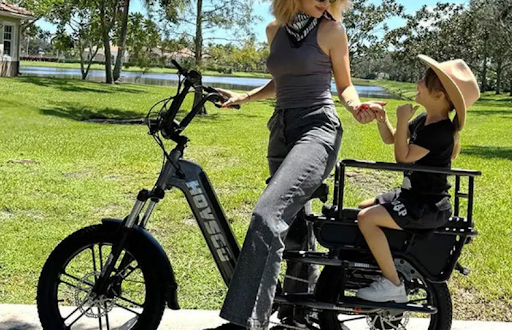
When reading about frame construction, look for specific engineering language around load-bearing capacity. A stated payload of 300 lbs or more, combined with information about frame testing and certification, tells you that the manufacturer has actually designed for the use case rather than estimated it. The range of HOVSCO Family E-Bikes demonstrates this clearly: models like the HovCart are engineered from the ground up for carrying children and heavy loads, with frame geometry and motor tuning matched to that specific purpose rather than adapted from a standard design.
Five-Point Harness Systems for Young Passengers
For children under about four years old, a five-point harness is essential. This is the same configuration used in car seats: two shoulder straps, two hip straps, and a crotch strap that connect at a central buckle. It distributes force across the body in the event of a sudden stop and prevents the child from sliding or tipping forward.
On front-load box bikes, the harness needs to be properly integrated into the box seating rather than added on as an accessory. Check that the attachment points are bolted through the box structure, not just clipped onto the seat fabric. Also check that the harness adjusts easily for different clothing thicknesses, because the fit that works in a summer t-shirt is very different from the fit you need when your child is wearing a winter coat.
For rear seats on longtail bikes, look for a full wraparound harness rather than just a lap belt. Children move around. A lap belt alone does not prevent forward pitching in a sharp stop.
One practical check before buying: put the bike on its kickstand and load the front box with something close to your child’s weight. Then push on the box from different angles. A well-engineered front box should feel solid with no flex in the mounting structure. Any wobble or movement at the base is a red flag.
Integrated Lighting That You Cannot Forget to Switch On
Forgetting to charge and attach clip-on lights sounds like a minor inconvenience until it happens on a dark November morning when you are already running late for school drop-off. Hard-wired lighting powered by the main battery removes the problem entirely.
Good integrated lighting on a family cargo bike means a bright front light with a beam shaped for urban riding rather than just raw brightness in a central cone, plus a rear light with enough visibility to be seen from a meaningful distance in daylight as well as darkness. Some systems also include side visibility strips on the frame, which makes a real difference at intersections where cross-traffic may not see you until the last moment.
Automatic light activation based on ambient brightness is a genuinely useful feature, not just a marketing point. When your hands are full helping children onto the bike, one less switch to remember is a real-world benefit.
A Double-Legged Kickstand That Actually Holds
This one gets dismissed as a minor detail, and it absolutely is not. Parking a fully loaded cargo bike on a single-leg kickstand while two children try to climb out simultaneously is a balance act that goes wrong more often than you would expect. A double-legged center stand that locks the bike level and stable changes every parking stop from a mild stress point into a non-event.
Look specifically for stands that have a positive locking mechanism, meaning the legs click into position rather than just resting there under the bike’s weight. On uneven surfaces like kerb edges or cobblestones, a stand without a positive lock can shift under the weight of the bike. With children on board, that shift can happen fast.
Motor Assist That Behaves Predictably Under Load
This might not seem like a safety feature in the traditional sense, but unpredictable motor behavior is a genuine hazard on a loaded cargo bike. If the motor surges abruptly when you start pedaling or cuts out suddenly on a hill, your ability to control a bike carrying 60 lbs of children is seriously compromised.
Torque-sensing motors are significantly more predictable than cadence-sensing motors. They respond proportionally to your pedaling effort rather than switching the assist on or off based on whether the pedals are moving. At the slow speeds and tight maneuvers that dominate family cargo bike riding, this smoothness is a direct safety benefit.
Something worth checking that many buyers overlook: ask specifically whether the motor assist cuts off gradually or abruptly at the speed limit. In some systems the assist drops off sharply at 15.5 mph or 20 mph, which can cause a sudden change in resistance that catches riders off guard. A smooth tapering cutoff is noticeably safer and more comfortable.
Weather Protection That Works in Practice
Rain covers, footmuffs, and windshields for the cargo area sound like comfort features, but they are safety-adjacent in a real way. A child who is cold, wet, and uncomfortable moves around more, fidgets with harness straps, and distracts the rider at exactly the moments when concentration matters most.
Quality weather protection that attaches securely and does not flap in the wind keeps children settled and the rider focused. For front-load bikes, look for covers with clear panels so you maintain visual contact with passengers. For rear seats on longtails, a good windshield reduces the wind chill enough to extend riding weather by weeks on either end of the season.
Reading the Full Picture Before You Buy
Safety features do not exist in isolation. How well they work together depends on the quality of the overall engineering, the fit between frame design and accessory system, and the consistency of the manufacturing. A hydraulic brake system on a poorly welded frame is only as safe as the weakest link.
Before committing to any family cargo bike, it is worth going deep on the technical side of what separates good options from average ones. The Electric Family Cargo Bike Guide covers motor power, battery capacity, and modular seating configurations in detail and gives a clear picture of which features actually matter for daily family use versus which ones look good in a brochure.
The families who are happiest with their cargo bikes are almost always the ones who spent time on the research side before they spent money on the purchase. A bike that ticks every safety box and suits your actual riding life will be used every single day. A bike with gaps in either area becomes a source of low-level stress every time you load the kids up, and that is not what this is supposed to feel like.