Vents MagaZine Music and Entertainment Magazine
Related Articles



Introduction
Online shopping has changed the way consumers purchase products and services. With a few clicks, customers can compare prices, read reviews, explore product features and complete transactions without visiting a physical store. For businesses, e-commerce platforms offer opportunities to reach wider audiences, increase sales and understand customer behaviour. However, the same digital environment has also created opportunities for certain questionable marketing and design practices.
Some online platforms use interface designs that encourage customers to make decisions they might not otherwise make. These practices can include displaying misleading discounts, hiding additional charges until checkout, making subscription cancellations difficult or creating unnecessary urgency through countdown timers. Although such techniques may improve short-term conversion rates, they can undermine consumer choice and damage the relationship between businesses and their customers.
These practices are commonly known as dark patterns. As regulators pay greater attention to digital consumer protection, businesses must understand how their website design, advertising strategies and checkout processes influence purchasing decisions. Recognising and addressing these practices is no longer simply a matter of good customer service. It is an important part of responsible e-commerce operations.
Understanding Dark Patterns in E-Commerce
To understand the issue, it is important to examine what is dark pattern in e commerce and why it has attracted attention from consumer protection authorities.
A dark pattern is a deceptive or manipulative design practice used in a website, mobile application or digital interface to influence users into taking actions that may not reflect their actual preferences. These designs often exploit consumer behaviour, limited attention, confusion or the difficulty of understanding complex information.
For example, an online shopping platform might automatically add an additional product to a customer’s cart without making the selection sufficiently clear. Another platform might highlight the option to purchase a premium subscription while making the option to continue with a basic service difficult to find.
The defining characteristic is not simply that a website encourages customers to purchase something. Businesses are entitled to promote their products and recommend relevant services. The concern arises when design choices interfere with informed decision-making, conceal important information or make it unnecessarily difficult for consumers to exercise their choices.
Dark pattern in e commerce can therefore take several forms, ranging from misleading price presentation to complicated cancellation procedures. Understanding these techniques helps businesses identify potential risks before they affect customers or attract regulatory scrutiny.
Common Types of Dark Patterns Used by E-Commerce Platforms
Dark patterns are not limited to a particular industry or business model. They can appear on online marketplaces, travel booking websites, food delivery applications, subscription services and digital payment platforms. Some common examples include:
1. False Urgency
False urgency occurs when a platform creates the impression that a customer must purchase immediately to avoid losing an opportunity.
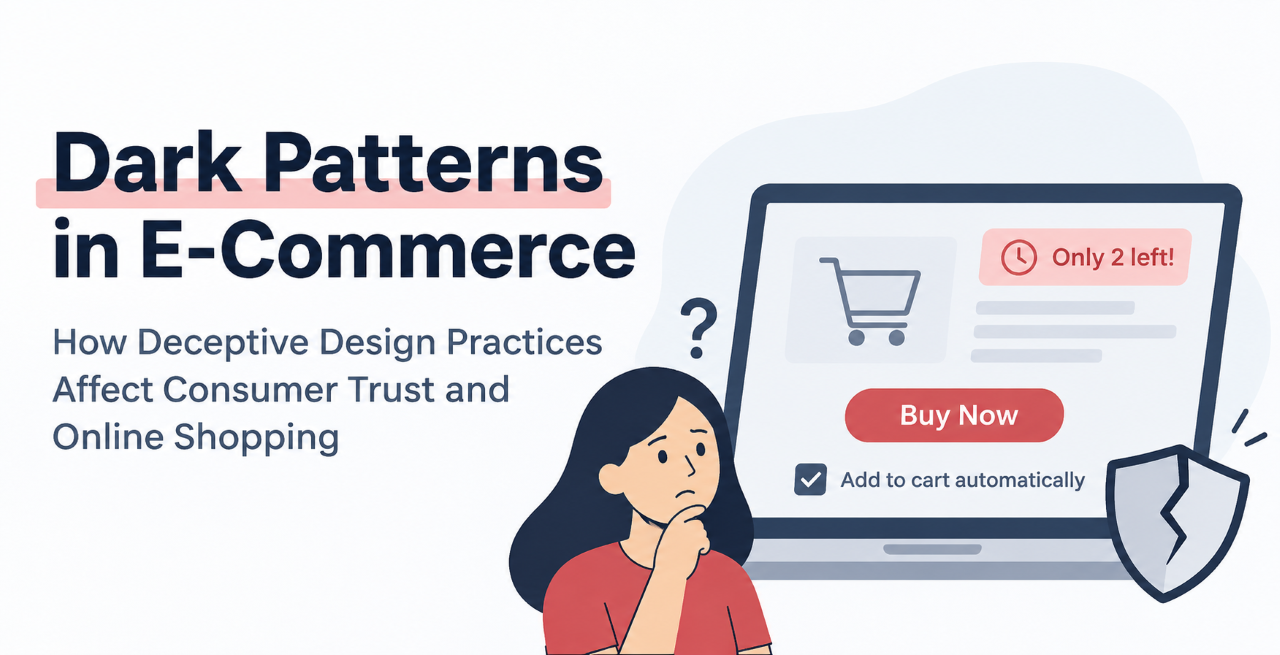
Examples include countdown timers that restart every time a page is refreshed or messages suggesting that a product is almost sold out without a reliable basis for that claim.
Genuine limited-time offers and low-stock notifications are legitimate business practices when supported by accurate information. The problem arises when businesses manufacture urgency to pressure customers into making rushed decisions.
2. Basket Sneaking
Basket sneaking refers to adding products, services, insurance or additional charges to a customer’s shopping basket without obtaining clear and informed consent.
For instance, a customer purchasing an electronic device may find an additional warranty or accessory included in the final order even though it was not deliberately selected.
Such practices can increase the transaction value temporarily, but they create confusion and reduce customer confidence. Every optional purchase should require an affirmative action from the customer.
3. Hidden Costs
Hidden costs occur when additional charges are introduced late in the purchasing process.
A product may initially appear affordable, but customers may encounter handling fees, platform charges, packaging costs or other mandatory payments at checkout.
Businesses should communicate the complete payable amount as early as reasonably possible. Transparent pricing helps customers compare alternatives and reduces the likelihood of disputes or abandoned transactions.
4. Confirm Shaming
Confirm shaming uses emotionally manipulative language to discourage users from rejecting an offer.
For example, a subscription pop-up might present the acceptance option as “Yes, give me the discount” while describing the rejection option as “No, I prefer paying more.”
Although this may appear to be a minor wording choice, it attempts to influence customers through embarrassment or guilt rather than providing neutral information.
5. Forced Action
Forced action occurs when consumers are required to complete an unnecessary activity to access a product or service.
For example, a shopping application might insist that users create an account, subscribe to promotional messages or share additional personal information before allowing them to complete a purchase that should reasonably be available without those steps.
Businesses should distinguish between information genuinely required to fulfil an order and information collected primarily for marketing purposes.
6. Subscription Traps
Subscription traps make it easy for customers to sign up for a service but difficult to cancel it.
A platform may offer a free trial that automatically converts into a paid subscription without sufficiently clear information about the renewal terms. Alternatively, customers may have to contact customer support, complete several steps or search through multiple pages to discontinue a service.
A fair subscription model should clearly communicate renewal dates, recurring charges and cancellation procedures before customers sign up.
7. Drip Pricing
Drip pricing involves gradually revealing additional charges during the purchasing process rather than displaying the complete cost upfront.
For example, an online travel booking platform may initially advertise a low ticket price but introduce convenience fees, service charges and other mandatory expenses towards the end of checkout.
This practice can prevent consumers from making meaningful price comparisons. Businesses should ensure that mandatory charges are disclosed clearly and at an appropriate stage of the transaction.
8. Disguised Advertisements
Disguised advertisements appear as ordinary content, recommendations or independent reviews, making it difficult for consumers to identify their promotional nature.
For instance, a shopping platform might display a sponsored product among organic search results without clearly identifying it as an advertisement.
Sponsored placements are a legitimate source of revenue for digital businesses. However, promotional content should be clearly distinguished from independent recommendations so that customers understand what they are viewing.
The Legal Framework Governing Dark Patterns in India
India has taken specific steps to address deceptive digital design practices through its consumer protection framework.
The Consumer Protection Act, 2019 provides the foundation for addressing unfair trade practices, misleading advertisements and violations of consumer rights. The Central Consumer Protection Authority (CCPA) is empowered to take action to protect consumers against practices that adversely affect their interests.
On 30 November 2023, the CCPA issued the Guidelines for Prevention and Regulation of Dark Patterns, 2023. These guidelines identify 13 specified dark patterns and establish a framework for addressing deceptive user interface and user experience practices across digital platforms.
The identified practices include:
- False urgency
- Basket sneaking
- Confirm shaming
- Forced action
- Subscription trap
- Interface interference
- Bait and switch
- Drip pricing
- Disguised advertisements
- Nagging
- Trick wording
- SaaS billing
- Rogue malware
The guidelines are particularly relevant to e-commerce businesses because they address how digital interfaces can influence consumer decisions. They also make it important for businesses to examine whether their website or application design could mislead users or interfere with their freedom of choice.
Another important provision is Rule 4(9) of the Consumer Protection (E-Commerce) Rules, 2020. It requires e-commerce entities to obtain consumer consent through explicit and affirmative action when recording consent for purchasing goods or services. Automatic consent, including through pre-ticked checkboxes, is not permitted.
Regulatory attention has continued beyond the introduction of the 2023 guidelines. On 5 June 2025, the CCPA issued an advisory encouraging e-commerce platforms to conduct self-audits to identify and address dark patterns. The advisory asked platforms to examine their practices and take steps towards maintaining fair and consumer-centric digital experiences.
This development sends a clear message to online businesses: reviewing digital interfaces for potentially deceptive practices should form part of regular business operations.
How Dark Patterns Affect Businesses and Consumer Trust
Some businesses may consider manipulative design techniques an effective way to improve conversion rates. However, focusing exclusively on immediate sales can create long-term commercial problems.
Loss of customer confidence: Customers who discover unexpected charges or unwanted subscriptions may lose confidence in the platform. They may hesitate before making future purchases or move to competitors that offer clearer pricing and policies.
Higher customer acquisition costs: Retaining existing customers is generally more economical than repeatedly acquiring new ones. If deceptive practices reduce repeat purchases, businesses may have to spend more on advertising and promotional campaigns to maintain revenue.
Increased complaints and refund requests: Unclear checkout processes, unwanted add-ons and confusing subscription terms can generate customer support tickets, payment disputes and refund requests. These issues also increase operational costs.
Reputational damage: Negative reviews and social media discussions can quickly draw attention to questionable business practices. For established brands, even a relatively small design issue can affect customer perception.
Regulatory exposure: Practices that fall within the scope of applicable consumer protection laws and guidelines may attract regulatory scrutiny. Businesses may also face consequences under other applicable legal provisions depending on the nature of the conduct.
For multinational companies operating across different markets, the issue becomes even more significant. A design practice that is acceptable under one jurisdiction’s rules may create compliance concerns in another. Businesses must therefore consider local consumer protection requirements when developing digital products for different regions.
Best Practices for Preventing Dark Patterns in E-Commerce
Preventing dark patterns requires cooperation between product designers, marketing teams, legal professionals, developers and business leadership. Rather than treating compliance as a final review before launching a website or application, businesses should incorporate consumer protection principles into their design and development processes.
The following practices can help:
1. Make Pricing Transparent
Display product prices, applicable taxes, delivery fees and mandatory charges clearly. Customers should be able to understand the total payable amount before reaching the final payment stage.
2. Obtain Clear Consumer Consent
Optional products, subscriptions, insurance and promotional services should never be added automatically. Every additional purchase should require a clear affirmative action.
3. Simplify Cancellation Procedures
Customers should have access to straightforward subscription cancellation and account termination options. Businesses should not introduce unnecessary steps simply to discourage customers from leaving.
4. Use Honest Promotional Messages
Countdown timers, stock availability notifications, discounts and promotional claims should reflect accurate information. Marketing teams should avoid creating artificial scarcity or misleading customers about the availability of offers.
5. Conduct Regular UX Audits
Businesses should periodically review their websites and applications to identify potentially deceptive design elements. These reviews should cover the complete customer experience, including registration, product selection, checkout, payment, subscription management and cancellation.
6. Involve Legal and Compliance Teams
Legal professionals should review significant changes to user interfaces, promotional campaigns and payment processes. Their involvement can help identify potential consumer protection concerns before a new feature reaches customers.
7. Evaluate Customer Feedback
Repeated complaints about unexpected charges, difficult cancellations or misleading discounts can indicate deeper problems in the platform’s design. Customer feedback should therefore be considered an important part of identifying and correcting questionable practices.
The Role of Ethical Design in the Future of E-Commerce
The future of e-commerce will increasingly depend on how businesses balance commercial objectives with consumer interests. Artificial intelligence, behavioural analytics and personalisation technologies are making it possible for companies to understand customer preferences in greater detail.
These technologies can improve product recommendations, simplify searches and make shopping experiences more relevant. However, they can also be used to identify consumer vulnerabilities and influence purchasing decisions in ways that may not serve the customer’s interests.
Businesses must establish clear boundaries around how these technologies are used. Personalisation should help customers find relevant products rather than manipulate them into purchasing unnecessary items. Similarly, recommendation systems should provide useful information without disguising sponsored content or withholding relevant alternatives.
Ethical design should also be considered during product testing. While A/B testing can help businesses understand which layouts perform better, conversion rates should not be the only measure of success. Companies should also assess whether customers understand the information presented, whether their consent is meaningful and whether they can easily reverse decisions.
For large businesses, these principles can be incorporated into internal design standards, product approval processes and periodic compliance assessments. Such measures can help create consistency across websites, applications and digital services.
Conclusion
Dark patterns in e-commerce represent a growing concern for consumers, businesses and regulators. Practices such as hidden charges, false urgency, basket sneaking and subscription traps may influence purchasing decisions, but they can also damage customer relationships and expose businesses to legal and reputational risks.
India’s Guidelines for Prevention and Regulation of Dark Patterns, 2023, together with the Consumer Protection Act, 2019 and the Consumer Protection (E-Commerce) Rules, 2020, provide an important framework for addressing these concerns.
For businesses, the most effective response is to make transparency and consumer choice central to digital product design. Clear pricing, genuine consent, honest promotions and accessible cancellation options are practical measures that support both consumer interests and long-term commercial performance.
Ultimately, successful e-commerce platforms should not measure their performance only by how many customers complete a transaction. They should also consider whether customers understand what they are purchasing and feel confident about the decisions they make. Building that confidence is essential for creating lasting customer relationships and maintaining trust in an increasingly competitive digital marketplace.