Vents MagaZine Music and Entertainment Magazine
Related Articles


Hi Antje, welcome to VENTS! How have you been?
I’ve been well, thank you!
No feels like a particularly significant turning point in your career, especially because it grew out of the personal awakening you experienced around turning 50. When did you realize that the changes you were going through were going to become a record rather than simply a private period of transformation?
I’m always in a low-grade state of songwriting. Like anyone, I’ll have passing thoughts as I go about my day. But when any of them strike me as poetic, I jot them down and put them in a song. Thus my songs tend to reflect the things I am thinking about virtually in real time. In this case, I was sick and fueled on prescription hormones for a year because of a uterine fibroid. The high hormones and intense illness unleashed this sense of irritation, exhaustion and “not caring” which was initially physical, but ultimately led to an expansion of self. I found myself saying things and letting loose emotions that I typically wouldn’t have. I was always taught to be diplomatic. My idea of “polite” was informed by the adage “if you don’t have anything nice to say, don’t say anything at all”. But with the illness, I didn’t have the strength to curate and sensor, and to my surprise when I unleashed a more blunt authenticity from that place of limited resources, I found that nothing bad happened and it was energy saving to simply be blunt. With that dawning came an anger that I had been laboring at meticulous diplomacy my whole life when those vested with power in our society don’t bother to filter their thoughts in this way. I was taught that is what a woman does.
So much of the album is about rejecting the idea that women have to be endlessly agreeable, accommodating, and “nice.” How did you begin recognizing the difference between genuine kindness and the kind of niceness that requires you to silence your own needs?
I was taught by my family system that acquiescing whenever possible is the “nice” and correct thing to do. To be kind, in this model, was to grant others as much advantage, space, agency and control as possible and take as little for yourself as possible. I didn’t question this version of “nice”, I prided myself in it – “I am just genuinely gentle and kind”. In retrospect, it served me to defer to others on the pretext of kindness because I didn’t trust my own gut. I didn’t know how to advocate for myself because I didn’t know what to advocate for. In my family, the men “had all the answers”. The women acquiesced. I was groomed to follow. Nobody encouraged me to believe I might have answers myself. So I assumed for a long time that I didn’t but that everyone around me did. My role was to defer to them and learn. When you don’t trust your own compass because you’ve not been shown that your compass is trustworthy as a girl, it doesn’t occur to you to push back, use your voice, or stake a claim. You don’t have a reason to be disagreeable when you don’t have an agenda of your own . In that sense, being nice was a defense mechanism. Once I found trust in my own compass, every fiber of my being screamed NO.
Anger is often treated as something that needs to be controlled or overcome, but No approaches it as a source of agency and even liberation. Did writing these songs change your own relationship with anger?
I understand that for some people reflexive anger is a problem. But for people like me, the real problem was the lack of it. It’s like being a rose without thorns. You’re incredibly vulnerable without it. Worse still, anger isn’t something you can manufacture. When I was 23, my therapist asked me to punch a pillow. I did so to please him but felt nothing. My anger hadn’t emerged yet. My moral compass and sense of outrage had to form from scratch. It took decades to rewrite the really fucked-up operating system instilled in me by my family and culture when I was young. Once I pieced it together and recognized that I had been groomed for complacency, anger came in spades and I took and take anger as a sign of health. An interesting component of this is the feedback loop between the anger brought by emotional healing and a deeper understanding and the more chemical, physiological component of anger. I think for a lot of women these two realms interplay during menopause. And it’s actually really powerful!
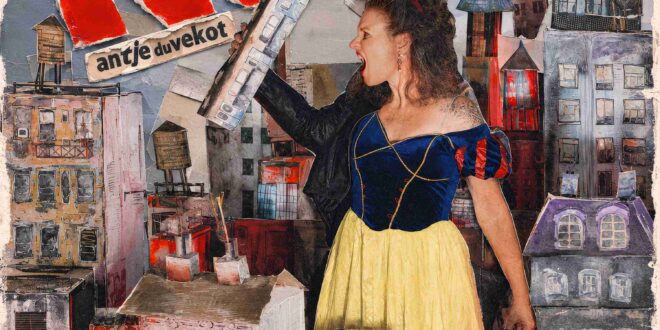
“Virginia, Unhinged,” “Godzilla,” and “Snow White” each approach liberation from a different angle. When you look across the album, do you see these characters as different versions of yourself, or are they vessels that allowed you to explore experiences you couldn’t have addressed as directly?
Yes, it’s no secret that my songs are usually about a corner of the self. “Virginia, Unhinged” came to me when I was feeling out of control emotionally due to the anemia brought by the fibroid, the oral hormones I was on, and other circumstances. My filter broke and frustrated feelings gave rise to devious fantasies – like burning the CVS to the ground (upon waiting in vain for important meds to be called in). Having always been prosocial and utterly rule following, letting myself feel “dark” feelings felt riveting and expansive. I think it’s given me more dimensions as a full human. I celebrated that in Virginia, a far gone female character that doesn’t give a fuck anymore. “Godzilla” came out of the unease that arises as you take up more space when you previously hadn’t. The phrase “too big for (her) britches” came to my mind as I was practicing my expansion. I thought about how gaslightey that metaphor is. If your “assigned britches” were extremely narrow to begin with, it is a good thing to be “too big for your britches”. Lastly, “Snow White” laments the dehumanizing aspect of online dating and life on the internet in general. It invites the female protagonist to step away from all “the voices” and trust in her own centered inner world instead, one that can’t be torn down by trolls and randos. I think the humor in this song will help bring levity to the experience many online daters have.
You’ve built your career around vulnerability and transforming deeply personal experiences into something universal. Was there anything about making No that felt more vulnerable than your previous records, even though the album is also much more confrontational?
Not really. I’ve always used full disclosure as a shame buster in my art. I am drawn to artists that use their own stories, however personal, to connect to those of others. I’ve always done that and continue to, but I think it started as a means of survival. Outing my full messy self felt preferable to being invisible back when I began as a songwriter three decades ago. Back then, it was a desperate attempt to not disappear. But overtime, I have continued to believe in this method and I have actively chosen it again and again, even from a more empowered place. It has shifted from that early place of needing to share to a place of wanting to share. But I’m still a big believer in the good that honest sharing brings and the conversation it engenders!
There’s a lot of humor, profanity, and irreverence on No, alongside some very serious emotional subjects. Did bringing that humor into the record give you a different kind of freedom, particularly when confronting things that had previously been difficult to say out loud?
I’ve always brought play into my songs. I think that’s just who I am. It’s always been my suspicion that people don’t actually know what they’re doing, and so it feels appropriate to the human situation to make light of all our bumbling and fumbling as humans. I’m always struck when someone says “it’s brave that you share your dysfunction”. Because I thought everyone is fallible, searching, dysfunctional…. If they are not, then the joke is truly on me 🙂 . But I find the best antidote to getting down on all the imperfection inherent in human relationships is to not take ourselves too seriously. I like to laugh lovingly at the funny wobbling phenomenon of inelegance that is this weird and crazy life, and I love to bring that sentiment to listeners. It also serves to lessen the feelings of pathology and weight of trauma. I laugh a lot about trauma with my friends. And then we turn back to the heavy work…. It can be both.
Your musical journey began after moving from Germany to the United States as a teenager, and that bicultural perspective became an important part of how you observed the world and wrote songs. Looking back now, how much do you think that outsider perspective still informs the way you write and interpret people?
The main takeaway I got from changing cultures at the age of 13 was that norms are mutable and downright arbitrary. Seeing the cultural differences between Germany and how things were done here in the US made me note that collective beliefs aren’t fixed and can be revised. That plays into this conversation. My album “No” is a conversation about which toxic parts of the culture should be ditched and which are keepers. As a young immigrant, I noticed some of the American toxic weirdness around the sexes early on. Upon arriving in American middle school from Germany, I was immediately struck by this intense role assignments along gender lines that were not present in Germany. Everyone – the adult world included – kept pushing a gender division onto us seventh graders. You were supposed to wait to be asked out for the dance, you were supposed to find a valentine, you were supposed to dress up like girls and boys. There were pink binders for girls, blue binders for boys. We were kids, but it felt like this rush to think of the other sex as opposite. It was prescriptive. There had been nothing like it in Germany. I think that’s where a lot of the toxicity of our American culture begins…..
You’ve worked with an extraordinary group of artists over the years, including Dar Williams, Anaïs Mitchell, Rose Cousins, Heather Maloney, John Gorka, and Lucy Kaplansky. How has collaborating with other songwriters and musicians over the course of your career influenced the way you approach your own voice?
People like Dar Williams and Ani diFranco in particular showed me that it is, in fact, “permissible” to be highly personal in your art, and that there are no limits on authentic self expression. I would have found ways to authentic expression without their music, but as a young person not yet used to paving her own way, getting this permission was invaluable and legitimized my pursuit. Those two writers in particular gave me the courage and strength to be vulnerable. At times, it’s heavy lifting to put so much of yourself out there. Ani and Dar are my companions on that road. And so it was extremely meaningful to have Dar guest on this album.
Seth Glier produced No, while your previous records involved producers such as Mark Erelli, Seamus Egan, Richard Shindell, and Scott Petito. What did Seth understand about these songs and this particular stage of your life that helped bring the album into focus?
Seth is just a sensitive and highly informed feminist man. He’s a thoughtful listener with a deep sense of justice. Also, we’ve been friends a long time and the trust born of many long-drive-conversations while touring together made me feel confident that he understood the album, not just musically but also in how it fits into my life right now and its mission. After a career filled with acclaimed songwriting, major festivals, touring, animation, and so many different creative chapters, what does saying “no” mean for Antje Duvekot now—and what are you finally giving yourself permission to say “yes” to?
I am saying yes to choosing rather than receiving what life has to offer. I am saying yes to trusting that wealth lies ahead. I’m saying no to the disempowering scarcity mindset that I was raised on. I am saying a big yes to the fact that I am more than my pretty looks or pretty voice or my soft and nourishing nature. I am saying no to being made culturally irrelevant as a 50 year old woman. I am saying yes to wild unabashed joy. After all, a good chunk of life is already over. If not now, then when.