 Vents MagaZine Music and Entertainment Magazine

Related Articles


Over the past few years, a new category of tools has emerged around what many developers and creators call no-code or vibe coding. These systems promise to translate ideas into software, content, or digital assets through simple and natural language prompts.
Early demonstrations were impressive. A user could describe a product idea and instantly receive code, layouts, or content suggestions. Yet for many users, the experience often stopped there. The tools generated drafts, but turning those drafts into something usable still required a surprising amount of manual work.
The gap between generation and deployment became the real bottleneck.
From Drafts to Deployment
Many AI tools today operate as advanced suggestion engines. A prompt produces code, design concepts, or written material. The user then reviews the output, makes changes, and prompts again. Each interaction moves the work forward, but the process remains iterative and incomplete.
In software development, this often means extra steps before anything can actually be used. Code may be generated, but someone still needs to connect databases, set up hosting, and make sure everything works together. In creative work, the process can involve moving files between tools, resizing images, formatting documents, or preparing content for different platforms.
The result is that work moves forward, but it rarely finishes itself. Ideas appear quickly, yet turning those ideas into something usable still requires time and coordination.
As AI tools became more common, this gap between generation and completion became easier to see. Many platforms can create drafts or suggestions, but fewer can carry work all the way through to a finished result. This difference has become a key point of comparison when evaluating newer AI systems designed for software creation and content production.
How Today’s AI Tools Actually Work
A number of platforms now attempt to simplify development or creative work. Tools such as ChatGPT, Replit, Cursor, and other coding assistants can generate large portions of code. Creative tools like Midjourney, Runway, Canva AI, and Adobe Firefly can produce images, video, and design assets in seconds.
These tools represent meaningful progress, but most of them still operate within a similar model. They generate pieces of work rather than completing the full process.
In many cases, users must connect multiple systems together to reach a final result. A design created in one platform may need editing in another. Code generated by an AI assistant still requires integration, debugging, and configuration before it becomes a working product.
Even large language models such as ChatGPT often require plugins, extensions, API keys, or technical configuration to unlock deeper functionality. For developers this may be manageable, but for non-technical users it can quickly become a barrier.
The Rise of Agentic AI
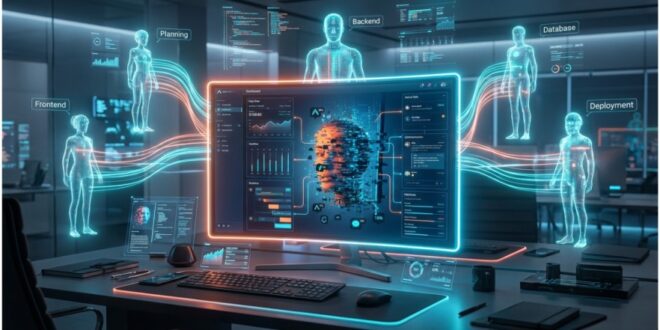
A new approach is beginning to emerge in response to this fragmentation. Rather than producing isolated outputs, some platforms are starting to focus on execution across the entire workflow. This shift is often described as agentic AI.
Instead of stopping after a response is generated, AI agents continue carrying work forward through multiple steps. The system interprets a user’s intent and completes tasks that once required manual coordination across different tools.
Many AI systems still operate as assistants. Tools such as ChatGPT; coding copilots, and other creative platforms can generate ideas, drafts, or pieces of code. However, users are often responsible for assembling those pieces, configuring systems, and preparing the final result.
Newer platforms are beginning to approach the problem differently.
One example is Famous.ai, developed by the parent company Famous Labs. Instead of focusing only on generating code or suggestions, the platform is designed to execute entire workflows. A user can describe a product or idea, and the system can generate the necessary structure, build components, configure services, and deploy a working result.
The difference may appear small at first, but it changes how these tools are experienced. Traditional AI systems respond to prompts. Agentic systems attempt to carry work forward until something usable exists.
For users, the difference quickly becomes clear. Some tools generate ideas that still need work. Others produce finished assets that can be used right away. When the goal is to bring something to market, the advantage of the second approach is hard to ignore.
Finishing the Work Matters More Than the Idea
For many creators and founders, the real challenge has never been generating ideas. The real challenge has been finishing them and bringing them into the world.
A marketing idea often needs several people before it can be shared with the public. A designer might make the graphics, an editor might review the message, and another person might format everything so it looks right.
A software idea can require even more steps. Developers may need to build the program and connect different tools before it works properly. Each extra step makes the process slower and harder to finish.
When tools focus only on generating ideas, that coordination still remains. However, when tools begin to handle execution as well, the entire workflow starts to change.
This shift is especially important for non-technical users. Tasks that once required development knowledge, design experience, or several different software tools can now happen within a single environment.
In practical terms, this means someone with little technical background can move from an idea to a working asset much faster than before.
Because of this change, the central question for users may no longer be whether an AI system can generate something interesting. The real question is whether the system can carry an idea all the way to reality.

