Vents MagaZine Music and Entertainment Magazine

Related Articles



Hi guys, welcome to VENTS! How have you been?
OLLY JAMES: Yeah we’ve been good thanks, excited to be putting new stuff out and for people to hear it!
The Liminal Tapes arrives as your debut EP, but there’s already a deep history behind the project. When did MERCERS begin to feel like its own identity rather than simply a continuation of the past?
OLLY: yeah that’s a good point, because originally when Phil and I started doing this there was no real plan to do anything more than just re-record some of the stuff off of Circles by way of hanging out and putting some old demons to bed – Fony never had anything out there on any streaming platforms for various reasons, plus we were never satisfied with the recordings. But we were proud of the songs, and thought they should be heard. So we decided to kill both those birds with one stone and re-record them as covers, but how we envisioned them when we wrote them, and now they’re gonna be out there for people to hear. Ironically it was through that process that we realised there was still a lot of creative chemistry there and it came at a time where the state of the world was giving me a lot of pause for thought and it made sense to put that into new music. So I think once we’d re-recorded the old Fony tracks, it felt like the purge was complete, but it had given us that hunger and here we are now! And then when Rich and Si came in and we had an immediate vibe and kind of creative understanding I think we all knew this was something in its own right.
With roots connected to FONY, how important was it for you to honour that legacy while also creating something entirely new?
OLLY: Well it was actually less about that and more about Phil and I rekindling a musical relationship to start with, as we’d kind of put off doing anything new for a long time. So it was really a way of doing that but also feeling comfortable, as those songs ran through our veins for so long. But yes, we were conscious of keeping the vibe of those songs true to how they were when we wrote them for sure, and I think you can still hear that in the way those covers came out. But as I mentioned, once that was done, the importance shifted to getting creative again and getting out of that comfort zone.
The name The Liminal Tapes suggests this sort of transition and in-between spaces. What does that title represent for the band personally and creatively?
OLLY: Yeah that title was very deliberate and is very literal. When we started out we very much had one foot in the past, and with that came not only the rekindling of a musical understanding, but also the insecurities shaped by some of those experiences, almost a reluctance to do more than those re-recordings. But it felt like there was a defined point when we started getting together as a band that this was going to be something more. So the whole process was very liminal in that for all of us, who’ve all been in bands before, it was a very “in-between” feeling putting this EP together. Being very conscious not to let the new tracks be shaped too much by past experiences, but being very aware of the fact that some of it would be, by definition, and that’s not necessarily a bad thing. So it’s liminal in both the positive and negative senses.
“Cleanse / Repeat” tackles heavy themes like Gaza and the erosion of Western democracy. What inspired you to channel those political realities into your music right now?
OLLY: I don’t normally go into my lyrics too much, but I think the themes and what I’m attacking here are quite obvious. And I think they needed to be to get the point across. It’s getting harder to ignore what’s going on in the world even from the comfort of our own situations. Especially from the comfort of our own situations. There’s a lot of heat on the Israeli government right now from people in the arts, and rightly so. And as a person of Jewish heritage I feel that very strongly – how can we use what happened back then as an excuse to perpetuate the very things that we faught so hard against?!! But I feel it goes deeper than that. Yes, we should be calling out Benjamin Netanyahu and the IDF for the ethic cleansing that is being carried out in the Gaza strip, but we need to be looking closer to home as well, at the huge Western nations that either stand by and do nothing or directly support the genocide by supplying arms and directly doing what they can to silence the people that speak up about it, under the guise of antisemitism. In the States but also over here. Democracy is becoming systematically converted into a dictatorship, where the people in power can bend the rules to suit a narrative that serves them best, not the people. And that has been happening, when you think about it, for centuries. The illegal war on Iran is another extension of that, which wasn’t even happening when I wrote those lyrics, and it’s sad that it makes them even more relevant now. As you can see, I’m quite passionate about these things, and I want to use any voice I have to express my discontent. So that’s what I’ve chosen to do.
Do you feel artists have a responsibility to speak on global issues, or is it simply a natural extension of your songwriting?
OLLY: That’s a good question. And a hard one. On the one hand, yes, I personally want to use my platform, however small or big it becomes, to raise awareness to things. But I’m also human and some of my lyrics are actually very personal so not everything needs to be one way or the other. We’re not a political band per se, but I can only write what I feel. On the other hand, free speech means you can express yourself as and how you want, and if you don’t want, you shouldn’t feel the pressure to. It’s like when people say “you must vote, people died for our vote” – well no, people have died for our RIGHT to vote, and that’s the same with artists, I think we all have a RIGHT to speak about global issues, and possibly should yes, but we also have the right to not speak out. Besides, there are plenty of other ways to make a difference.
Reworking older songs like “A Satire for the World” and “January Zen” must have been an interesting process. How did time and perspective change the way you approached those tracks?
OLLY: I think we’ve grown up in the intervening years and it’s allowed us to look back at them away from the kind of pressure situation that we were in back then – by the end of that time we were burnt out and weren’t really getting on as a band. We were young and we didn’t really understand that we had choices, and for a lot of reasons that I’m not going to go into now, we didn’t have those choices. It had become much more a business than a band and that definitely tarnished our feelings towards the music. But yeah, as I said earlier, rekindling with Phil with older heads on our shoulders and knowing we were doing it in the right way and for the right reasons helped us realise the importance of those songs, on a personal level but also the pride that we feel having written those songs. They’re great songs and it has been a real privilege to rediscover them for what they were outside of that pressure.
“New Stockholm” explores mental health and free speech. Why did those themes feel important to address together?
OLLY: Those two themes kind of came together by accident in that song. I was going through a period of introspection when we wrote that, but there was also the inescapable reality of what was happening with ICE in the States right now and the stark truth that our right to protest over there and over here in the UK without punishment is under real threat. So it’s not so much about those two themes being interwoven, as that the lyrics parallel those themes, and you can look at them one way in terms of being beholden to the part of you that struggles from a mental health perspective, so much that you end up kind of forming an affinity with it, and from another angle you can look at them as a depiction of the brutal response to the people that just want to have their voices heard during a protest. But in both those situations there is an element of Stockholm Syndrome, where we feel almost protective of those bad parts of ourselves / the system.
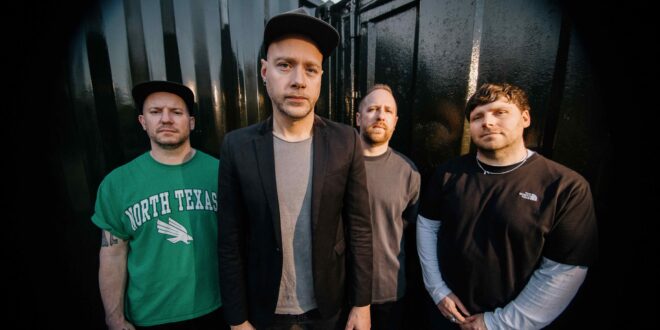
The EP is described as more open and expansive sonically. How did adding Richard Titheradge and Simon Glover help shape that evolution?
OLLY: I mean, those guys have made this real. They aren’t just session musicians to a project that Phil and I were doing, they are the band. You can hear it in Satire and Jan Zen, they aren’t just playing what they heard on the original versions, you can really hear their style, little nuances that give those tracks a different personality. Rich in fact had a huge hand in the writing of New Stockholm as well, so it really is a band vibe. And one of the biggest things that has come from the passing of time is that there are no egos to deal with, and none of that youthful stubbornness, we all trust each other in what we do, and if something sounds good, it sounds good, it doesn’t matter who’s come up with it. But also, it’s just fun. They are good guys, and we all share the same values and love for the music we’re doing, so we get to hang out, have fun and make music!
There’s always pressure when introducing a new project tied to a respected past band. Did you feel expectations coming into MERCERS, or did the creative process feel liberating?
OLLY: I think I’ve kind of answered this earlier. But yeah, I think going from revisiting those old tracks to discovering we still had that chemistry and feeling that artistic excitement happened so naturally we haven’t really thought about it in terms of expectations. We’re just excited to be doing something new.
For listeners discovering MERCERS for the first time through The Liminal Tapes, what do you hope they understand about who this band is and where it’s headed next?
OLLY; we just hope that people enjoy it as much as we have putting it out there! And that they’re excited to see us in a town near them when we get out on the road.