Vents MagaZine Music and Entertainment Magazine

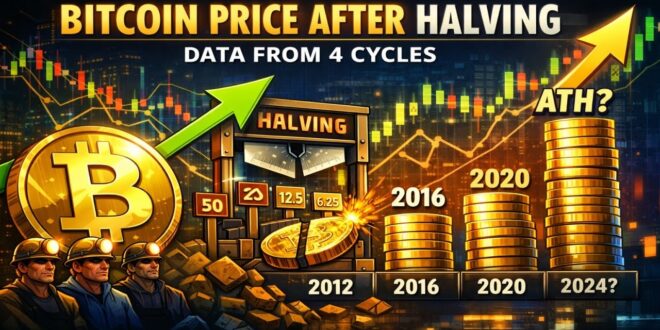
Bitcoin halving is one of the most watched events in cryptocurrency. Every four years, the reward miners earn for processing transactions gets cut in half. The core question most people ask: Does Bitcoin halving actually move the BTC price?
The short answer from three completed cycles: yes, but not right away. Meaningful BTC price increases have started several months after each halving, with cycle peaks arriving 12 to 18 months later. Percentage returns have also declined with each cycle as Bitcoin’s market has grown.
This guide walks you through the verified data, the repeating patterns, and what the 2024 halving cycle looks like so far. No speculation, just the numbers.
What Is Bitcoin Halving?
Bitcoin halving is a built-in rule coded into the Bitcoin protocol. It happens approximately every four years, specifically every 210,000 blocks mined.
When Bitcoin launched in January 2009, miners earned 50 BTC per block. Each halving cuts that reward in half:
• 2012: 50 BTC reduced to 25 BTC
• 2016: 25 BTC reduced to 12.5 BTC
• 2020: 12.5 BTC reduced to 6.25 BTC
• 2024: 6.25 BTC reduced to 3.125 BTC (April 20, 2024)
This reduces the rate at which new Bitcoin enters circulation. Bitcoin has a fixed maximum supply of 21 million coins. The halving schedule is the mechanism that enforces that cap.
Think of it as a supply throttle. It does not stop new Bitcoin from being mined, but it slows the daily inflow by half overnight.
The most recent halving occurred on April 20, 2024, at block 840,000. You can verify this on-chain at Blockchain.com.
Bitcoin Halving History: All 4 Cycles at a Glance
The table below uses closing price data from CoinMarketCap and Coinbase historical records. Prices are approximate and based on widely reported figures.
| Halving | Date | Reward Change | Price at Halving | Post-Halving Peak | Time to Peak | ROI from Halving |
| 1st | Nov 28, 2012 | 50 > 25 BTC | ~$12 | ~$1,150 (Nov 2013) | ~12 months | ~9,000%+ |
| 2nd | Jul 9, 2016 | 25 > 12.5 BTC | ~$650 | ~$19,900 (Dec 2017) | ~17 months | ~2,950% |
| 3rd | May 11, 2020 | 12.5 > 6.25 BTC | ~$8,600 | ~$68,700 (Nov 2021) | ~18 months | ~700% |
| 4th | Apr 20, 2024 | 6.25 > 3.125 BTC | ~$64,000 | ATH ~$126,000+ (Oct 2025) | ~18 months | Cycle ongoing |
Important: Past performance does not guarantee future results. Bitcoin is a volatile asset and prices can fall sharply at any time.
Bitcoin Price After the 2012 Halving
The first halving took place on November 28, 2012. Bitcoin was trading around $12 at the time.
The price did not react immediately. Over the following months, gradual buying pressure built up. By November 2013, roughly 12 months later, Bitcoin reached approximately $1,150. That represented a gain of over 9,000% from the halving price.
Key Context
This was Bitcoin’s first major price cycle. Adoption was limited, infrastructure was basic, and the buyer base was almost entirely individual enthusiasts. Low liquidity amplified every move, which is why percentage returns from this era are far higher than later cycles.
What This Means for You
Do not expect 2012-style percentage returns in today’s market. Bitcoin now has a market cap measured in trillions, making such gains arithmetically very difficult. The 2012 cycle is a reference point for timing, not magnitude.
Bitcoin Price After the 2016 Halving
The second halving happened on July 9, 2016. Bitcoin was priced near $650.
The immediate reaction was flat. Bitcoin price actually dipped in the weeks following the event. A meaningful rally did not begin until late 2016. By December 2017, about 17 months after the halving, Bitcoin hit approximately $19,900.
Key Context
This cycle coincided with a wave of retail interest across many countries, growing media coverage, and the early rise of the broader cryptocurrency market. Initial Coin Offerings (ICOs) drove additional speculative demand into crypto assets generally.
What This Means for You
The 6-month delay between the halving and the start of the rally is an important pattern. Markets take time to absorb reduced supply. Investors who sold on halving day left significant gains on the table.
Bitcoin Price After the 2020 Halving
The third halving occurred on May 11, 2020. Bitcoin traded near $8,600, in the middle of economic uncertainty caused by the COVID-19 pandemic.
After a slow recovery through the second half of 2020, price momentum accelerated sharply in early 2021. Bitcoin reached an all-time high near $68,700 in November 2021, approximately 18 months after the halving.
Key Context
Two forces combined in this cycle. Government stimulus programs across the U.S. and Europe injected significant liquidity into financial markets. At the same time, institutional investors, including MicroStrategy, Tesla, and several hedge funds, began allocating to Bitcoin for the first time at scale.
What This Means for You
This cycle showed that macro factors, specifically interest rates, monetary policy, and institutional flows, can amplify or delay halving-driven moves. Bitcoin no longer trades in isolation from traditional financial markets.
Key Patterns From the Last 3 Completed Halvings
When you look at all three completed cycles together, four consistent patterns stand out:
• No immediate price reaction. The halving day itself rarely produces a strong move. Short-term dips or sideways trading are common.
• Rallies begin 3 to 12 months later. The market needs time to absorb the supply reduction while demand builds in the background.
• Cycle peaks arrive 12 to 18 months post-halving. This has been consistent across all three completed cycles.
• Percentage returns decline with each cycle. 9,000% in 2012, around 2,950% in 2016, around 700% in 2020. A larger market moves less dramatically on a percentage basis.
These patterns provide a useful framework. They are not guarantees. Each cycle has introduced new variables that earlier cycles did not have.
How Long After Halving Does Bitcoin Typically Peak?
Here is the timing data from each completed cycle:
| Cycle | Halving Date | Peak Date | Months to Peak |
| 2012 | Nov 2012 | Nov 2013 | ~12 months |
| 2016 | Jul 2016 | Dec 2017 | ~17 months |
| 2020 | May 2020 | Nov 2021 | ~18 months |
| 2024 | Apr 2024 | Ongoing | TBD |
The consistent range across all three completed cycles is 12 to 18 months. No cycle peaked within the first 6 months of a halving.
Is the Bitcoin Halving Already Priced In?
This is a genuine debate among analysts, and there is no settled answer.
The argument that it is already priced in: Bitcoin’s halving schedule is public and has been known since 2009. Sophisticated traders anticipate the event well in advance, which front-loads some of the demand.
The argument that it is not fully priced in: Even if expectations are baked in, the actual daily reduction in new supply still unfolds in real time. If demand stays steady or grows while fewer coins enter the market, basic supply and demand supports higher prices over time.
Research from Glassnode shows that post-halving periods have historically seen reduced sell pressure from miners, which contributes to price support regardless of pre-event speculation.
The realistic answer is somewhere between the two positions. Expectations matter, but so does the actual supply change.
What Has Happened After the 2024 Halving?
The fourth halving took place on April 20, 2024, at approximately $64,000 per Bitcoin.
Several factors make this cycle different from previous ones:
• Spot Bitcoin ETFs launched in January 2024. BlackRock, Fidelity, and other major asset managers now offer regulated Bitcoin exposure. These products brought billions in new institutional demand within the first months.
• Bitcoin reached a new all-time high before the halving. This had not happened in any prior cycle. Bitcoin hit approximately $73,700 in March 2024, before the halving even occurred.
• Macro conditions shifted. The U.S. Federal Reserve began a rate-cutting cycle in September 2024, which historically benefits risk assets, including Bitcoin.
Bitcoin crossed $100,000 in December 2024, around 8 months after the halving. It reached approximately $126,000 in October 2025, marking a new all-time high at that point. The cycle continued into 2025 with ongoing price discovery.
You can track the current BTC price and on-chain data at CoinMarketCap and Glassnode.
Risks and Misconceptions to Know
Several common misunderstandings come up around halving events. Here is what the data actually shows:
• The halving does not guarantee a price increase. It reduces supply. Whether price rises depends on whether demand keeps up or grows.
• External events often drive more price action than the halving itself. Regulatory changes, macroeconomic conditions, and institutional flows have all proven to be stronger short-term drivers.
• Cycles do not repeat identically. Market structure evolves. The 2024 cycle already looks different from 2020 in timing and the instruments involved.
• Bitcoin is a volatile asset. 30% to 50% corrections have occurred within longer bull markets. Only invest what you can afford to lose entirely.
Key Takeaways
Here is what three completed halving cycles tell us:
• No halving has produced an immediate price reaction. Flat or sideways action in the weeks after is normal.
• Significant rallies have started 3 to 12 months after the event.
• Cycle peaks have historically arrived 12 to 18 months post-halving.
• Percentage gains have declined with each cycle as the market has grown.
• The 2024 cycle has so far tracked historical patterns but with ETF-driven institutional demand as a new variable.
Use halving data as one input among many. Combine it with macro conditions, on-chain data, and your own risk tolerance before making any investment decisions. For more information, visit cryptowealthnet.
Frequently Asked Questions
Does Bitcoin always go up after a halving?
Historically, Bitcoin has shown price strength in the months to years following each halving. However, it has never risen immediately on halving day, and broader market conditions can delay or offset gains. There is no guarantee.
How long after a halving does Bitcoin typically peak?
Based on the three completed cycles, peaks have arrived between 12 and 18 months after the halving event. In 2012 it took about 12 months, in 2016 about 17 months, and in 2020 about 18 months.
Which halving produced the highest returns?
The 2012 halving produced the highest percentage returns, over 9,000% from the halving price to the cycle peak. This is because Bitcoin was at a very early stage with low prices and minimal adoption. Later cycles have produced lower percentage gains as the market has scaled.
Will the 2024 halving cause a bull market?
The halving reduces daily new supply, which historically has supported higher prices when demand holds steady or grows. The 2024 cycle has already seen Bitcoin set new all-time highs. Whether a sustained bull market follows depends on institutional demand, macro conditions, and regulatory developments. No outcome is certain.
Should I buy Bitcoin before or after a halving?
There is no single best strategy. Many investors use dollar-cost averaging (buying fixed amounts at regular intervals) rather than trying to time halving events precisely. This approach reduces the risk of buying at a short-term peak and removes the pressure of predicting exact entry points.
What is the next Bitcoin halving?
The next halving is expected around April 2028, when the block reward will drop from 3.125 BTC to 1.5625 BTC.