Vents MagaZine Music and Entertainment Magazine

Related Articles


As described in the Mid-America Performing Arts Alliance (MAPAA)’s published profile, Hiebert Hall is not presented as a conventional concert venue in Lawrence, Kansas, but as a cultural landmark that began as a private home and was shaped over decades by Gunda and Dave Hiebert’s commitment to making music a regular part of community life. After moving to Lawrence in 1971 and building their life in the Alvamar neighborhood, the couple hosted an in-home classical concert in 1996 that clarified a simple reality: their home could no longer contain what they were trying to do. That same year, they purchased the historic house on University Drive that would become known as Hiebert Hall.
In the years that followed, the space developed its own rhythm. Before Dave Hiebert passed away in 2021, the couple had already hosted more than 1,000 home concerts there; today, the hall has presented more than 1,100 recitals featuring performers from around the world, and its programming has extended beyond classical music to include other formats. This long-running commitment is grounded in a clear belief that Gunda Hiebert has articulated publicly: “There are plenty of people who fund scientific things. What is it that can take you to a different dimension, or bring comfort, or help a troubled soul? Music. Music is the key!”
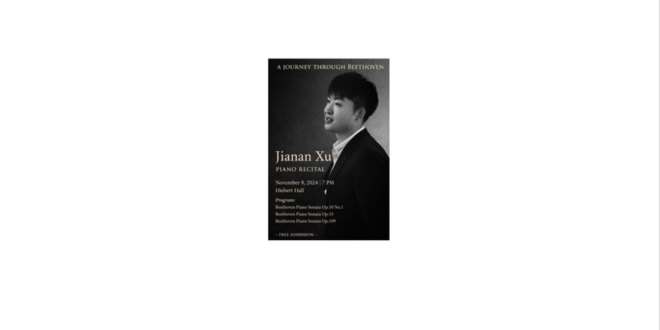
Against this backdrop, a piano recital at Hiebert Hall on Friday, November 8, 2024 carried more than the weight of a single evening’s program: it unfolded inside a space built around sustained listening, long-form hospitality, and an unusually consistent commitment to presenting music up close.At the invitation of Mrs. Gunda Hiebert, renowned Chinese pianist Jianan Xu appeared in concert, offering the audience an evening of exceptionally demanding solo performance. Active on both solo and chamber-music stages, Xu’s performance work has taken him across Europe, China, and the United States. As a pianist known for solo repertoire, he places particular emphasis on the overall conception of a program, highlighting internal connections between works and the sense of an unfolding musical narrative.
After accepting the invitation, Xu devoted substantial time to shaping and researching the program, ultimately making a bold decision: to perform three complete Beethoven piano sonatas from the composer’s early, middle, and late periods in a single concert. Such programming is uncommon in the solo piano world. Beethoven’s sonatas are often expansive in scale; a single work frequently exceeds twenty minutes, and some approach half an hour. Presenting three complete sonatas in one evening places extraordinary demands on stamina, concentration, and structural control. Over nearly ninety minutes of high-intensity performance, the pianist must sustain precise memory, clear architectural pacing, and continuous expressive tension.
Explaining the motivation behind this choice, Xu noted that Beethoven stands as one of the most representative figures in Western classical music history, and that the piano sonatas trace almost the entirety of the composer’s life. From his inheritance of Classical tradition, to the heightened struggle of the middle period, and onward to the introspective, transcendent world of the late works, these sonatas are not only milestones in music history but also reflections of Beethoven’s lived experience.
“Beethoven’s life was full of hardship,” Xu remarked. “He endured the devastating blow of gradually losing his hearing, and in his later years he suffered from illness. Because of this, his compositions in different stages of life present artistic worlds that are completely different, yet equally profound.”
By presenting sonatas from Beethoven’s early, middle, and late periods within a single concert, performer and audience were able—within the span of one evening—to see directly the evolution of the composer’s style and inner world.
Once the concert poster and performance details were released, the event quickly drew attention within the local music community. Among those in attendance was Dr. Frank Baron, a scholar of German Renaissance studies who had worked in Munich, underscoring the recital’s appeal across academic and cultural circles.
On the night of the concert, Hiebert Hall was filled to capacity, and the atmosphere was focused and energized. With rigorous musical logic, Xu completed the evening’s demanding program. Over nearly ninety minutes of almost uninterrupted playing, he realized the large arc shaped by the three sonatas, allowing listeners to immerse themselves in the evolution of Beethoven’s compositional voice across a lifetime.
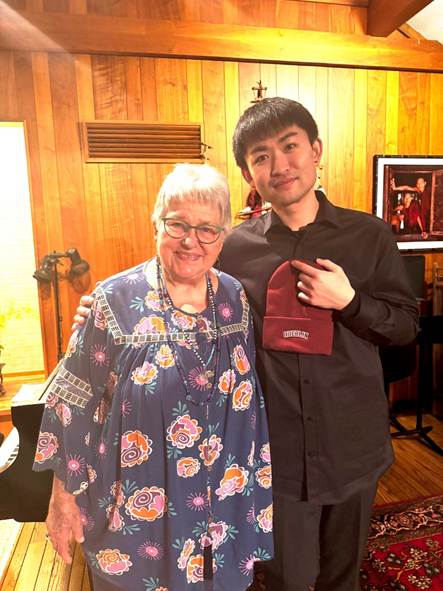
At the close of the performance, the audience responded with warm, sustained applause. Mrs. Gunda Hiebert then formally introduced Jianan Xu to the audience and offered her heartfelt admiration:
“I can’t imagine how he managed, with almost no rest, to complete three full Beethoven piano sonatas from different periods in one sitting. Tonight’s concert condensed and fused Beethoven’s compositional character and spiritual world across his entire life onto a single stage.”
The success of the recital also led to further artistic continuation. Later that same month, Mrs. Hiebert extended another invitation—this time to Xu’s wife, fellow pianist Nan Hu. In that subsequent concert, Hu selected three Bach keyboard concertos, presenting the refined and profound spirit of Baroque music through a clear, lucid, and rational approach. Xu appeared alongside her as accompanist, and the two musicians completed the program through a poised, restrained musical dialogue marked by close rapport.
In this way, two concerts presented within the same month at Hiebert Hall not only brought different musical eras and styles into dialogue, but also reaffirmed the role this private venue continues to play in contemporary cultural life: a gathering place that connects musicians, scholars, and listeners in a shared musical space.